Skybridge — moving pilots' flight logs from CloudAhoy to Flysto
A focused webapp that migrates pilots' recorded flights from CloudAhoy to Flysto. Concept, code, UI, and brand were built end to end with Codex and Claude as our second engineer.

Skybridge is a focused webapp that moves a general-aviation pilot's recorded flights from CloudAhoy into Flysto, automatically and in one sitting. Every layer of the product, from the concept to the React frontend to the Python backend, was built with Codex and Claude as our second engineer, and the brand around it was shaped in the same partnership. This is a case study in what "AI elevates an idea into a real product" looks like when the team is one studio, one model partner, and a clear shape to ship into.
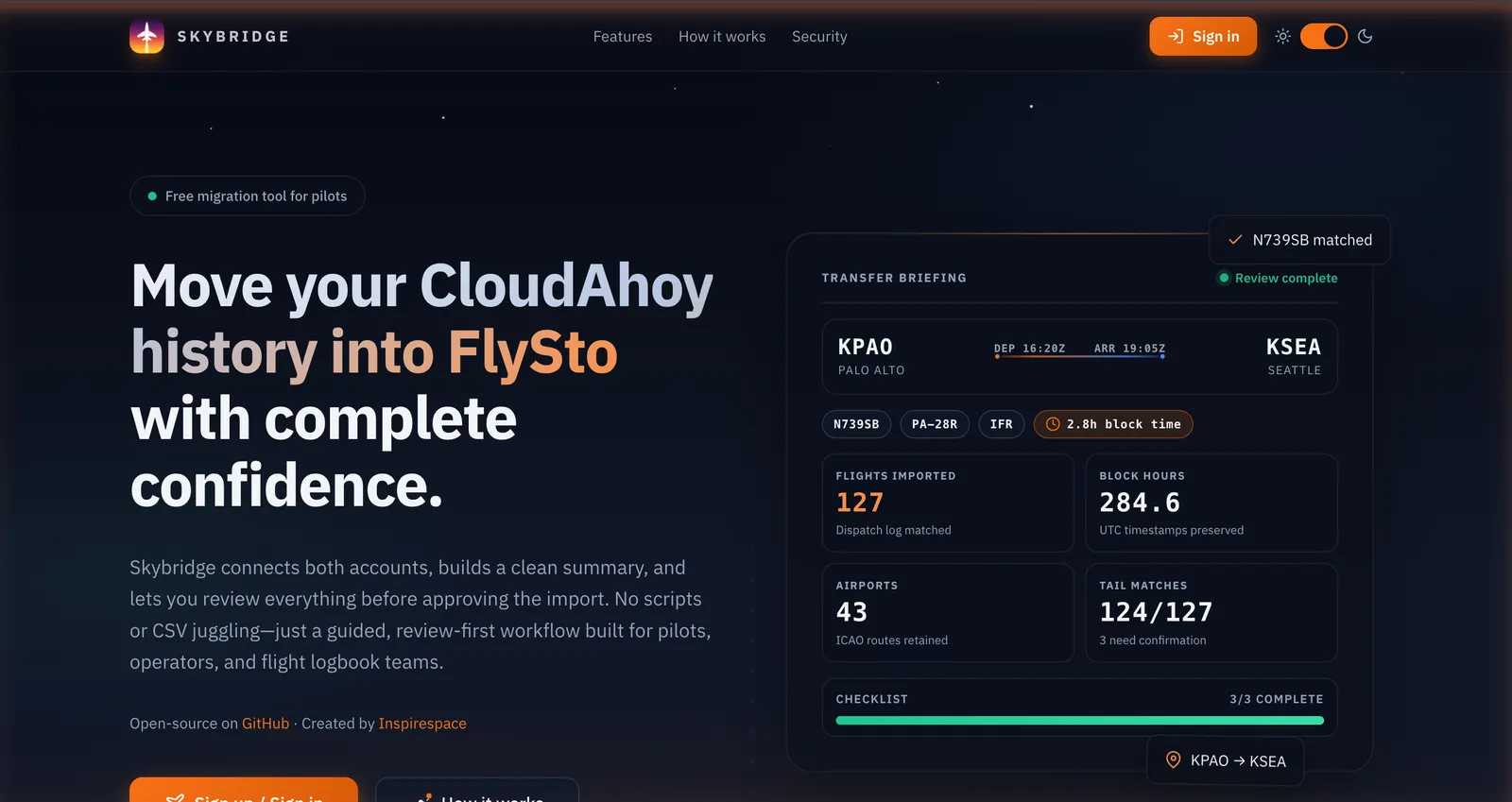
The problem
CloudAhoy and Flysto are both flight debrief platforms. Pilots use them to replay what actually happened in the cockpit: the trajectory, the altitude and speed tape, the per-flight metadata that turns a recording into a coachable moment. Neither platform exports cleanly into the other, and a manual move loses exactly the parts that make the data useful, the high-resolution trajectory and the metadata around it. It is the kind of small, real-world integration headache nobody is going to ship a venture-funded product for, and a stranger has to trust it with credentials for two services they care about.
Why we built it
A pilot in our orbit hit the wall. The idea sat on a list of "would be nice" things until we decided to use it as a deliberate test of how far the AI-as-collaborator method could go on a constrained, well-shaped problem. Outside our home stack, outside our usual brand work, with a clear deliverable and no marketing budget. Either the method worked well enough to ship something a real pilot would use, or it did not. The whole point of running the test on ourselves was that we could be honest about the answer.
How it works
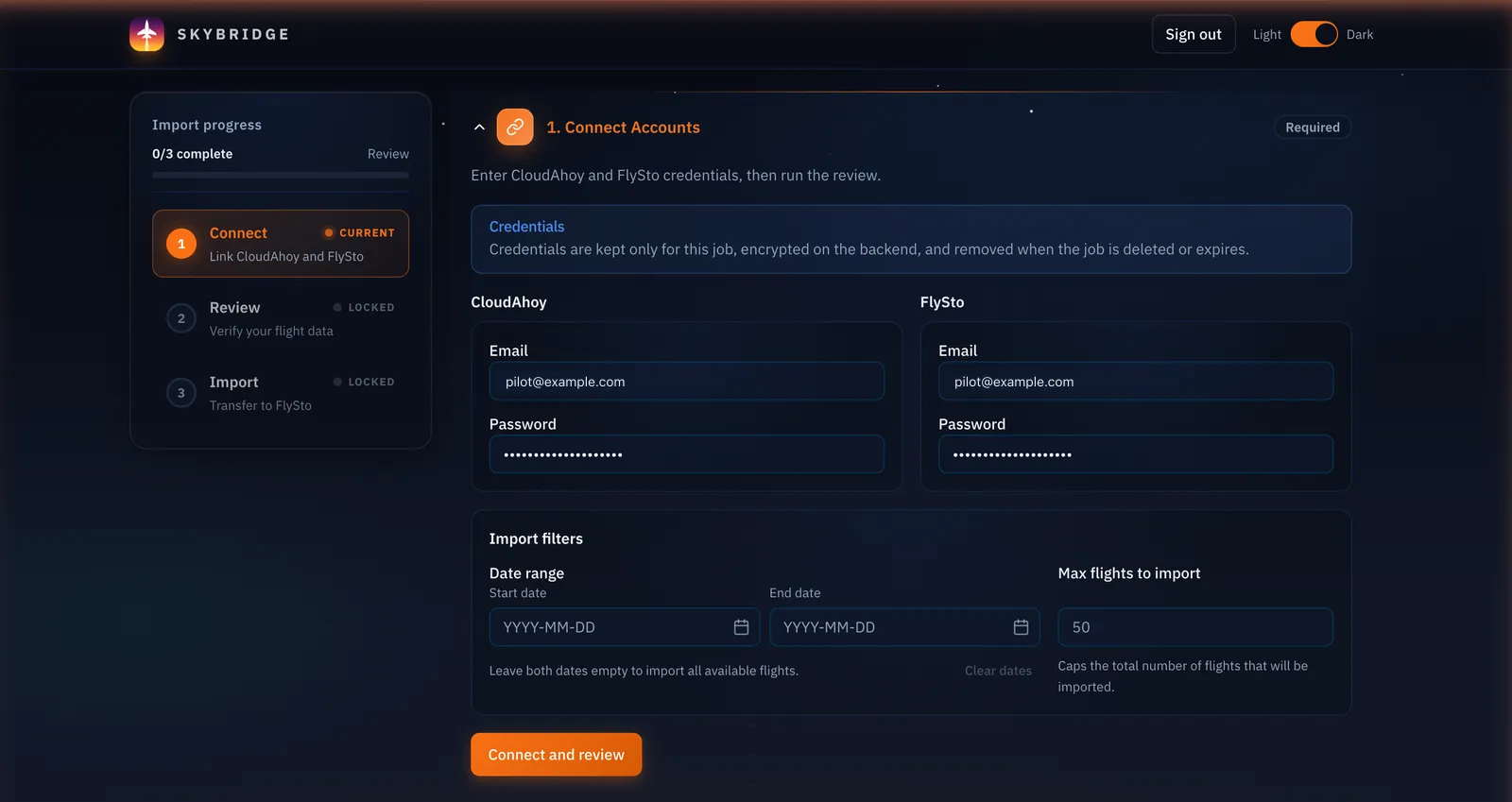
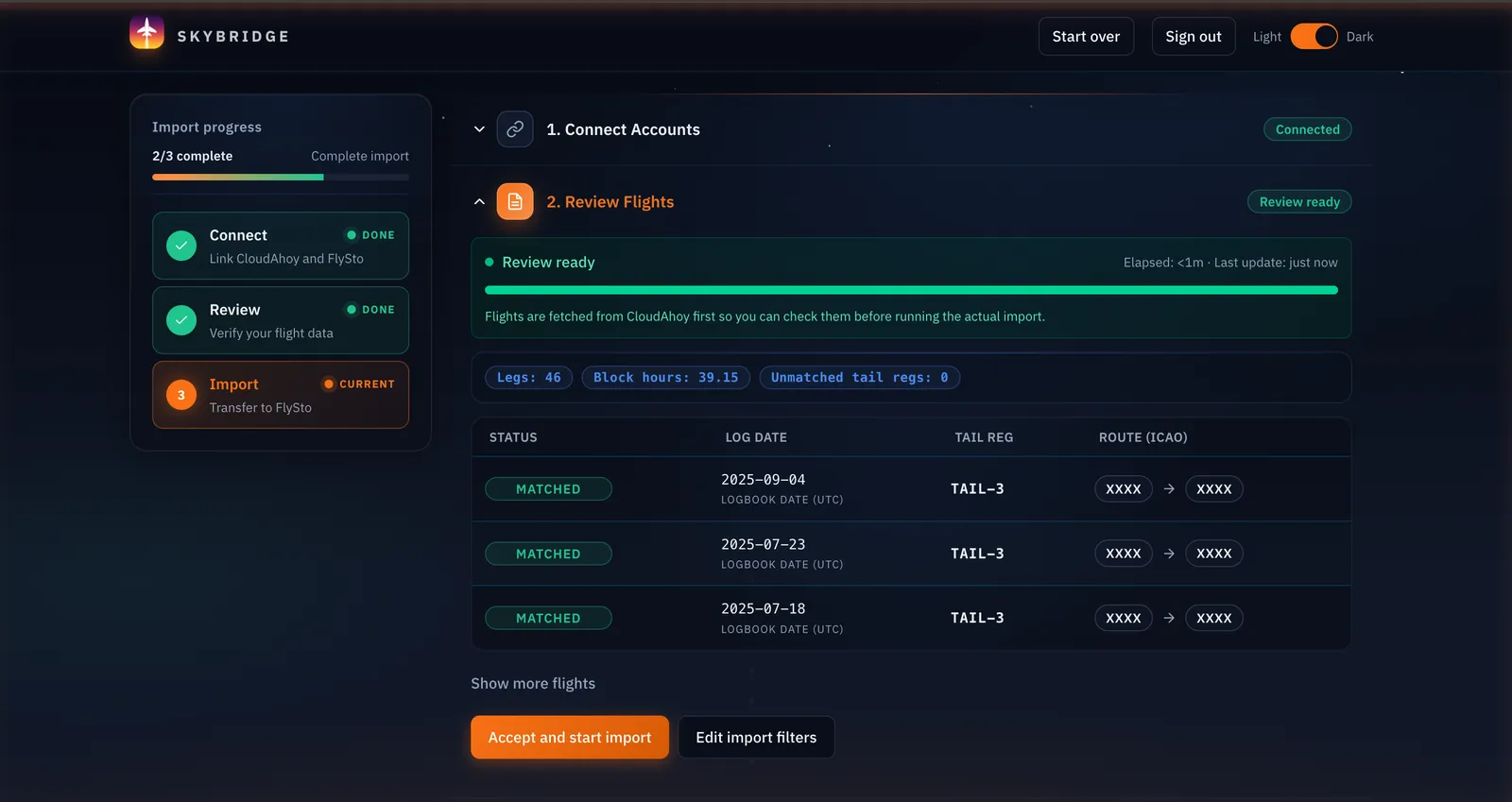
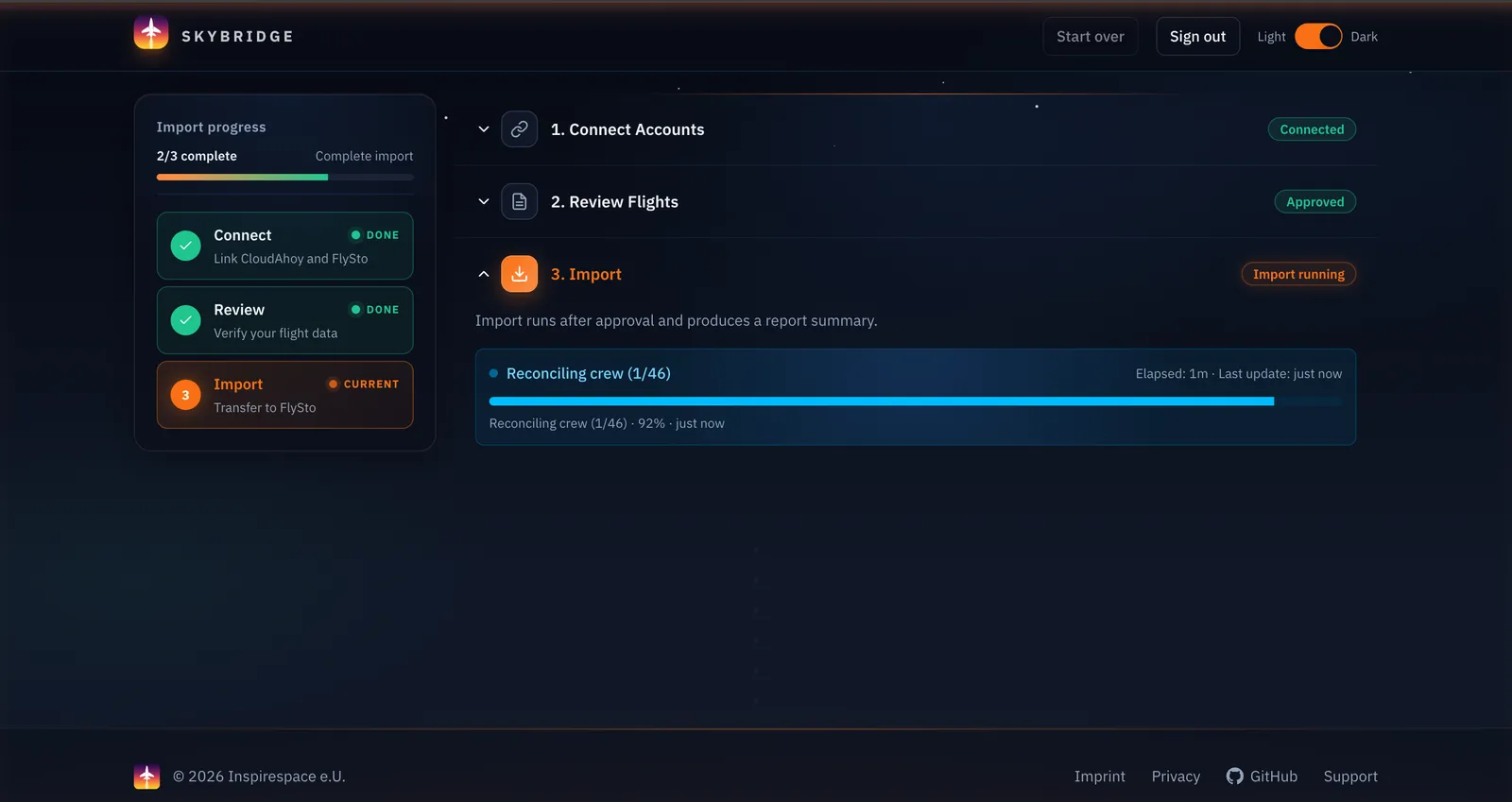
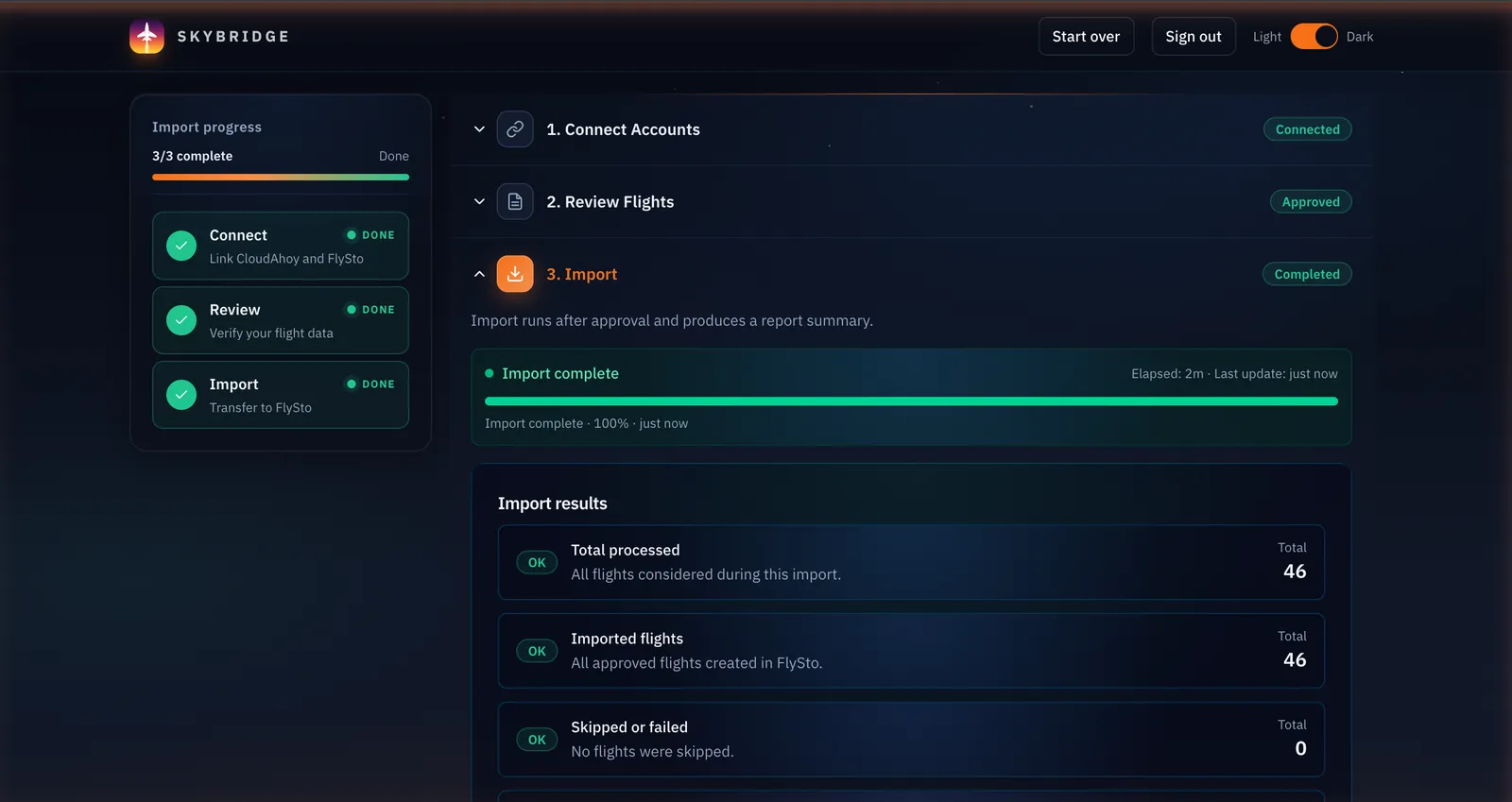
The flow is three steps, each one its own card in a single page. Connect asks for CloudAhoy and Flysto credentials and an optional date range or flight cap. Review fetches the matching flights from CloudAhoy and shows them in a table so you can verify what is about to move before anything moves. Import transfers the approved batch to Flysto with a live progress bar and a per-flight status log. Results stay available for download for seven days, then they are deleted. The product never makes a destructive change without an explicit checkbox first.
Building it with Codex and Claude
The repo is open source at github.com/inspirespace/skybridge. It runs to several hundred commits, paired with Codex and Claude in turn, with the human end of the pair holding the design brief, the code review, and the calls about what was good enough to ship. The leverage is not in typing speed. It is that the model holds the whole project in context. That changes the cost of throwing work away. When the first version of a tricky module is not right, the second one starts from understanding why instead of from a blank page. So you actually do throw the first one out, and the version that ships is usually the third or fourth. On a one-person studio's clock, that compression is the thing that makes a product like this feasible to build at all.
Designing the brand with Codex and Claude
The visual language is aviation cockpit at night, warm at the horizon. Horizon orange #FF8833 is the signature, sky blue #E0E9FF carries quiet space, altitude green #00A86B belongs to the success state, and the body type is IBM Plex Sans throughout. The Skybridge logo, an aircraft silhouette over a purple-to-orange dawn, took the longer route. We worked with our AI pair on directions and concept sketches, including the dawn metaphor and the upward thrust of the aircraft, then drew the final mark by hand from the strongest one. The brief had to land at favicon scale and feel like it belonged on the front of an aviation product without resorting to wings-and-shield clichés. The brief framed the work. The drawing was the work.

What it taught us about AI as a partner
The bottleneck moves. When the model writes faster than you can read, the work is not in the writing, it is in the judgement: is the second attempt better than the first, does this chunk of code justify itself, is this line of copy earning its place, does this interaction do what a pilot actually needs. These are the ordinary questions a studio already asks. What changes is how many of them you get to ask per hour. The leverage is the compounded weight of those small, ordinary calls.
How Inspirespace works
Skybridge is the kind of project we run for ourselves so we know the method works before we run it for clients. We bring the opinions, the brand line, and the call on what good looks like. Codex and Claude bring the throughput. The client brings the domain and the things only they know about the people who will use the product. If your idea is the right shape for a focused tool, talk to us about how we work. The shorter the clock, the better this method gets.