Rebuilding Inspirespace in six days with Claude Code
A six-day rebuild from empty repo to live Astro on Cloudflare Workers. One human and one AI, pair programming from design to deploy.
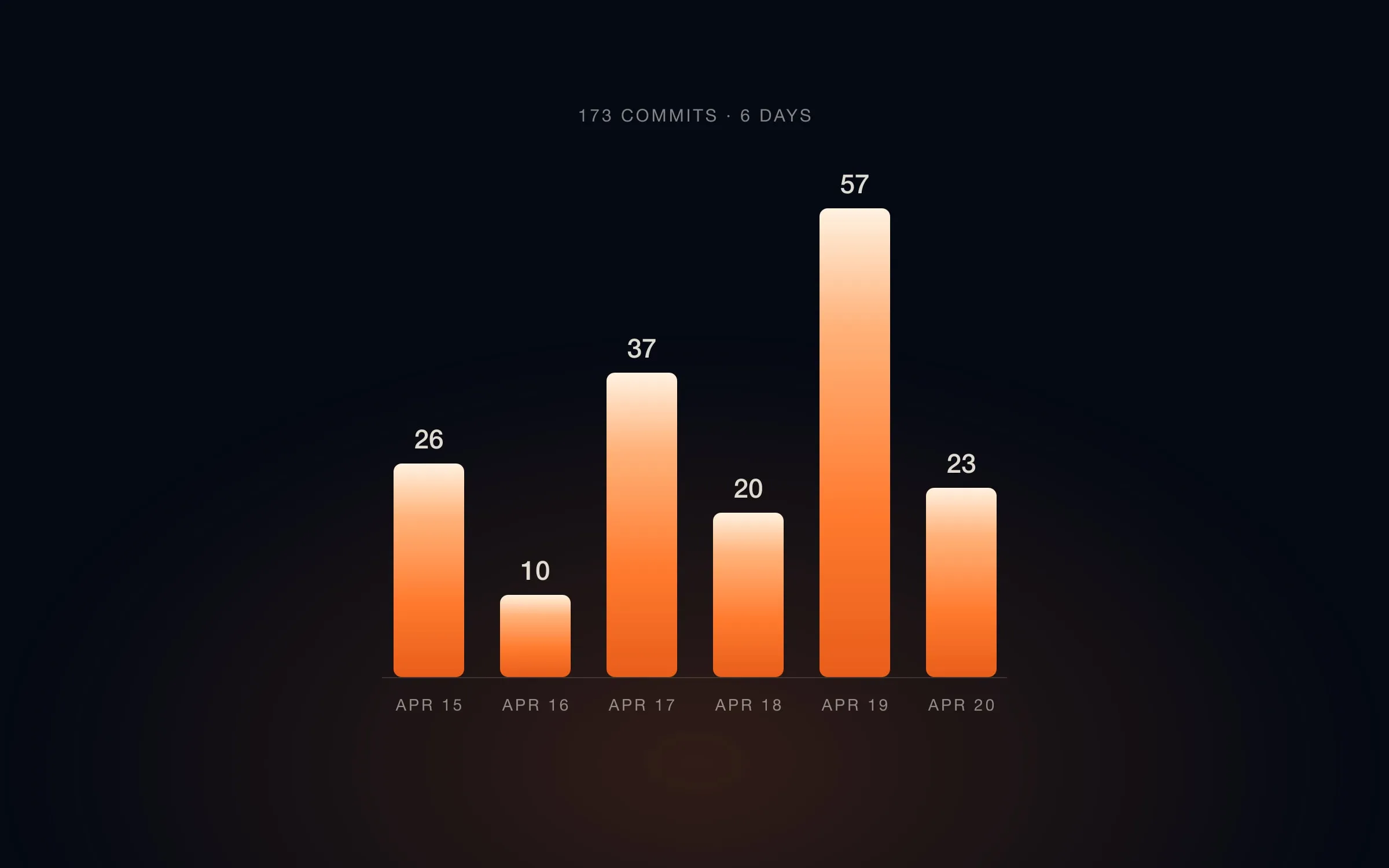
Every page on this site, its visual design, its content pipeline, its deploy infrastructure, was rebuilt in under a week with AI as the second engineer. Between April 15 and April 20, 2026, we took inspirespace.co from an empty repository to a live deploy on Cloudflare Workers, pair programming with Claude Code every step of the way. 173 commits, 17 merged pull requests, one human and one AI. This is the story of how, and more importantly, what the method feels like when it works.
The brief we gave ourselves
The old inspirespace.co was a WordPress site we built and kept in good shape. Nothing was on fire. What pulled us to a rebuild was a combination of two things. First, a different posture: a statically hosted site with a smaller attack surface, faster first paint on slow networks, and no runtime dependency on a database server a marketing site does not really need. Second, a design overhaul. We wanted something visually modern, more ambitious than the old layout, with motion and interaction details that would be genuinely time-consuming to hand-craft alone. That is exactly the territory where Claude Code shines, and the rebuild was a chance to lean into it. On top of that, one sharper question to answer: can a team of one human and one AI ship a production marketing site in under a week without the result feeling like a prototype. We set a six-day clock, opened a blank repo, and started writing.
Starting point: one empty commit
We started from an empty repository. We did not migrate in place, because migrating in place would have forced every decision about the new stack to route through the shape of the old one. Starting blank sounds risky on a six-day clock. It was not. The content worth keeping was a small, well-defined set: eight case studies, four blog posts, three legal pages, a handful of images. Carrying that shape across by hand is faster than reverse-engineering it from a database export, and every hour we did not spend on import scripts was an hour spent building the new site.
Day 1 and 2: four landing pages, not one
On the first two days, Claude Code produced four complete landing-page variants, not sketches or moodboards but fully worked HTML with its own typographic voice. We called them night-flight, cockpit, horizon, and orbit. All four were kept as HTML snapshots, a paper trail of the design directions we chose against. Orbit won, on the strength of a detail we could only judge by looking: the way the accent gradient reads at small scales, on a phone screen in bright daylight, where the other three became noise. This was the first moment where the pair-programming model felt qualitatively different from solo design. Exploring four directions in parallel is a thing you plan a month for with a design team. We did it in two days because the cost of the second, third, and fourth variant dropped to almost zero.
Day 3: scaffolding the site in a single sitting
On day three we scaffolded Astro 6, ported the winning landing page, and began the content migration. Most of the heavy lifting happened in one long pass, with the human end of the pair giving brief prompts, quick reviews, and course corrections, while Claude Code did the mechanical work of schema design and content carry-over. Eight case studies and four blog posts were lifted out of WordPress, normalised into Markdoc with Zod-validated frontmatter, and wired into a Keystatic schema that will power the headless admin when we turn it on. Markdoc lets us ship custom figure and gallery tags inside content files without writing React. Zod catches invalid frontmatter at build time so a typo in a tag never ships. The Astro content layer collects it all into a typed collection we can query from anywhere on the site. It is the kind of architecture that normally takes a week of careful decisions. Compressed into a day, the decisions still had to be careful, just faster.
Day 4: SEO parity, in a day
The old WordPress site served blog posts directly at the site root, not under a /blog/ prefix. Years of inbound links pointed at those URLs. Losing them would have been an unforced ranking loss on day one. On day four we rebuilt the URL shape exactly: posts still live at their original slugs, work case studies under /work/, legal pages at their canonical paths, every trailing slash preserved. A single JSON-LD graph builder emits Organization, Person, WebSite, BreadcrumbList, and Article or CreativeWork nodes per page, cross-linked so Google and AI crawlers can traverse relationships without fetching extra documents. Sitemap, hreflang for the one German post, breadcrumbs, legacy redirects: all of it landed in a day. Not because any piece was hard. Because the pair kept the context of every piece in play at once.
Day 5: a ten-phase design-token refactor
By day five we had a working site, and also a subtle mess. Every component had a spacing dialect, a font-size ladder, a breakpoint or two hard-coded into a media query. The fix was a single-source-of-truth CSS token system, a JavaScript mirror for motion scripts to read from, and a CI check that fails the build if any media query references a breakpoint not listed in the token set. Rolled out in ten phases, forty commits, one day. The playbook now exists as a document we can reuse on client work. The point was not the refactor. The point was that a thirty-minute conversation about "do we clean this up now or later" ended with the cleanup done, because the cost had collapsed from a week of delicate edits to an afternoon of orchestrated ones.
Day 5 and 6: the apex redirect saga
Every site rebuild has the moment where something small gets tricky. For us it was the apex-to-www 301 redirect. We wanted inspirespace.co to 301 to www.inspirespace.co. Cloudflare offers a dashboard redirect rule for this. We chose to own the redirect in code, inside the Worker itself, so future-us could search the codebase for the behaviour instead of remembering which dashboard tab to click. That decision uncovered a second one. By default, Cloudflare's static-assets binding serves matching requests straight from the asset store, bypassing the Worker entirely. Requests to the apex matched a static asset, and our redirect branch never fired. The fix was a single line of Cloudflare config that routes every request through the Worker first, before the asset binding gets a look. Three pull requests tell the full story. The lesson: on serverless platforms, the defaults optimise for the common case, which is not always your case. Owning the redirect in code made it easy to discover the mismatch, fix it, and write it down.
Day 6: polish, and the actual deploy
The last day was the reassuring kind of boring. A content accuracy pass. GitHub Actions wired up for code review and PR assistance. Matomo analytics added, honouring Do Not Track. Syne and Inter shipped via self-hosted variable fonts, no Google Fonts call at first paint, so the site is GDPR-clean from the first byte. Cover images are processed by Sharp into responsive WebP on every build. Type checking and accessibility linting run as a single command. The deploy ran green on the first push.
What it took, what it did not
What it took: one human and one AI, 173 commits, 17 merged pull requests, six days. Strong opinions about what "good" looked like at each layer, held consistently across thousands of small decisions. A willingness to throw away the first three design variants to ship the fourth. What it did not take: a team of six. A quarter of runway. A migration consultant. An analytics vendor. A headless CMS with a monthly bill. The work that felt impossible a few years ago, rebuilding a public marketing site with real content, real SEO, real accessibility, real GDPR posture, on a deadline short enough to fit inside a holiday week, is now a thing a very small team can do in a week. The multiplier is not typing speed. It is the ability to hold four directions in mind at once, explore them all, and pick the one that survives contact with the details.
If this shape fits your team
If your site is a tired WordPress stack with a slow editing loop, or a greenfield project that needs SEO from day one and GDPR compliance out of the box, the method we used on ourselves is the method we use for clients. We bring the opinions. Claude Code brings the throughput. You bring the content and the judgement about what good looks like in your market. Read more about how we work, or talk to us about what the six-day clock would look like for your next rebuild.